Данный раздел посвящён созданию информационного пространства наших проектов и, в частности, документированию.
Информационное пространство позволяет взаимодействующим с проектом людям ориентироваться в нём, разбираться с доступным функционалом проекта.
Для разработчиков основное инфопространство занимают описания внутренних элементов проекта - используемые функции, методы, типы и значения переменных. Для сообщества и пользователей основной является информация о возможностях самого продукта и о правилах взаимодействия с ним. При поддержке продукта основную часть инфопространства заполняет описание и струтуризация всех проводящихся изменений проекта.
В общем, информационное пространство - это огромный пласт разработки, охватывающий каждую её часть. Мы же в рамках этого раздела сделаем упор на техническое документирование проекта
Источники информации
Обсудим, как вообще в нашем проекте собирается информация по его внутреннему и внешнему функционалам.
Основной источник информации - документирование самих исходников. Его можно разбить на два основных типа документирования:
- Комментарии - Для оформления понятного информационного документа существует множество методик. Одна из самых популярных - Literate Programming - была в 1981 предложена Дональном Кнутом. По его методике для проекта пишется большой информационный текст с описанием всех примеров, и туда добавляются вставки описываемого языка программирования;
- Документирование API - Очень важная часть документирования. В первую очередь продукт разрабатывается для пользователей, и если не сопроводить его информацией, как этим продуктом пользоваться, проект загнётся вне зависимости от всех его уникальностей и преимуществ. Документация это первое, что должно меняться при изменениях.
Документирование API может поддерживаться внутренними особенностями языка (например, в Python поддерживается автодокументирование функций за счёт обработки “повисших” строк) или с помощью систем синтаксического разбора кода, причём как универсальных (Sphinx, Doxygen), так и ориентированных на конкретный язык программирования
Не менее важным является обеспечение общего взаимодействия и унифицированное ведение документации в сообществе. Большую работу в этой сфере провёл Роберт Мартин, выпустивший множество работ по дисциплине разработки, стилю оформления проектов, структуре каталогов, наименованию и назначению файлов (классический пример оформления - GNU Hello)
Непосредственное оформление справочников с документацией также имеет свои особенности. Говоря об offline-справочниках, нельзя не упомянуть классические help и man, в которых подробно и без лишней информации описываются все основные параметры и результаты работы описываемых утилит. Ещё одним форматом справочника выступают разного рода генераты и гипертексты, полученные из документированных исходников. Систем документирования бесчисленное количество, каждая из них поддерживает разные форматы выходной документации, включая LaTeX, HTML и так далее. В online-документировании полученные справочники могут выкладываться самостоятельно с помощью выгнанной HTML-документации, с помощью специализированных движков (wiki, Pelican и т.д.), сервисов совместной разработки (README.md на Gitlab/Github, Github Pages на Github.io…) или с помощью специализированных сервисов (ReadTheDocs, Git Book …)
Doxygen
В данном курсе будем разбираться именно с этим документатором. Doxygen - многоязыковая система с кучей приятных бонусов и возможностей. Работает от по принципу синтаксического анализатора — комментарии специального вида прямо в коде считываются и обрабатываются системой. При этом Doxygen поддерживает форматные комментарии и другие дополнительные
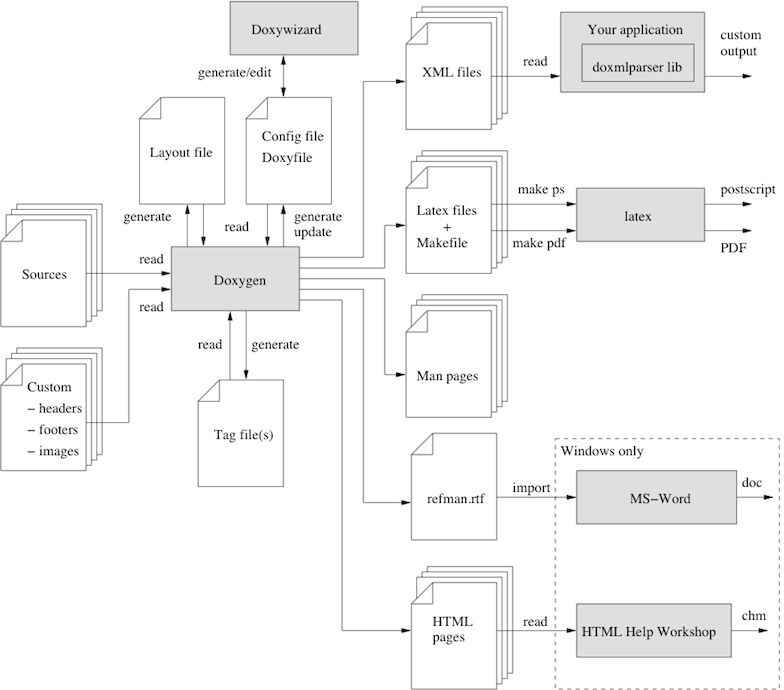
Процесс создания документации вкладывается в уже ставший нам привычным процесс автосборки проекта через configure. Для начала из исходных файлов мы собираем шаблонные файлы для параметров документации, затем заполняем их, указываем формат итоговой документации, собираем проект
Разберём пример из предыдущего раздела, навесив на него документацию
Для начала создадим шаблонный базовый файловый описатель Doxyfile.in
user@localhost:~/LinuxAppDev/11_Documenting/Lection/namegen> doxygen -g Doxyfile.in


Configuration file 'Doxyfile.in' created.

Now edit the configuration file and enter

  doxygen Doxyfile.in

to generate the documentation for your project

user@localhost:~/LinuxAppDev/11_Documenting/Lection/namegen>
user@localhost:~/LinuxAppDev/11_Documenting/Lection/namegen> cat Doxyfile.in | wc
   2884   21302  129104
user@localhost:~/LinuxAppDev/11_Documenting/Lection/namegen>
Это наш базовый настройщик документации. Эти почти 3000 строк - в большинстве своём комментарии, описывающие параметры, которые мы можем менять. Вот некоторые поля из этого файла:
Doxyfile.in
# The OUTPUT_DIRECTORY tag is used to specify the (relative or absolute) path
# into which the generated documentation will be written. If a relative path is
# entered, it will be relative to the location where Doxygen was started. If
# left blank the current directory will be used.

OUTPUT_DIRECTORY       =

# If the CREATE_SUBDIRS tag is set to YES then Doxygen will create up to 4096
# sub-directories (in 2 levels) under the output directory of each output format
# and will distribute the generated files over these directories. Enabling this
# option can be useful when feeding Doxygen a huge amount of source files, where
# putting all generated files in the same directory would otherwise causes
# performance problems for the file system. Adapt CREATE_SUBDIRS_LEVEL to
# control the number of sub-directories.
# The default value is: NO.

CREATE_SUBDIRS         = NO

# Controls the number of sub-directories that will be created when
# CREATE_SUBDIRS tag is set to YES. Level 0 represents 16 directories, and every
# level increment doubles the number of directories, resulting in 4096
# directories at level 8 which is the default and also the maximum value. The
# sub-directories are organized in 2 levels, the first level always has a fixed
# number of 16 directories.
# Minimum value: 0, maximum value: 8, default value: 8.
# This tag requires that the tag CREATE_SUBDIRS is set to YES.

CREATE_SUBDIRS_LEVEL   = 8

# If the ALLOW_UNICODE_NAMES tag is set to YES, Doxygen will allow non-ASCII
# characters to appear in the names of generated files. If set to NO, non-ASCII
# characters will be escaped, for example _xE3_x81_x84 will be used for Unicode
# U+3044.
# The default value is: NO.

ALLOW_UNICODE_NAMES    = NO

# The OUTPUT_LANGUAGE tag is used to specify the language in which all
# documentation generated by Doxygen is written. Doxygen will use this
# information to generate all constant output in the proper language.
# Possible values are: Afrikaans, Arabic, Armenian, Brazilian, Bulgarian,
# Catalan, Chinese, Chinese-Traditional, Croatian, Czech, Danish, Dutch, English
# (United States), Esperanto, Farsi (Persian), Finnish, French, German, Greek,
# Hindi, Hungarian, Indonesian, Italian, Japanese, Japanese-en (Japanese with
# English messages), Korean, Korean-en (Korean with English messages), Latvian,
# Lithuanian, Macedonian, Norwegian, Persian (Farsi), Polish, Portuguese,
# Romanian, Russian, Serbian, Serbian-Cyrillic, Slovak, Slovene, Spanish,
# Swedish, Turkish, Ukrainian and Vietnamese.
# The default value is: English.

OUTPUT_LANGUAGE        = English

# If the BRIEF_MEMBER_DESC tag is set to YES, Doxygen will include brief member
# descriptions after the members that are listed in the file and class
# documentation (similar to Javadoc). Set to NO to disable this.
# The default value is: YES.

BRIEF_MEMBER_DESC      = YES

# If the REPEAT_BRIEF tag is set to YES, Doxygen will prepend the brief
# description of a member or function before the detailed description
#
# Note: If both HIDE_UNDOC_MEMBERS and BRIEF_MEMBER_DESC are set to NO, the
# brief descriptions will be completely suppressed.
# The default value is: YES.

REPEAT_BRIEF           = YES
Теперь заполним наш шаблон, а также внесём его в configure.ac
configure.ac
#                                               -*- Autoconf -*-
# Process this file with autoconf to produce a configure script.

AC_PREREQ([2.69])
AC_INIT([Stupid fantasy name generator], [0.0.1], [george@altlinux.org], [namegen])
AM_INIT_AUTOMAKE([foreign])
DX_INIT_DOXYGEN([namegen]) # внесли описание Doxygen
LT_INIT([disable-static])
AC_CONFIG_SRCDIR([src/namegen.c])
AC_CONFIG_HEADERS([config.h])

# Checks for programs.
AC_PROG_CC

# Joint pkgconfig library/include tests
PKG_CHECK_MODULES([CHECK],[check])

# Variable definitins
AC_SUBST(CK_VERBOSITY, verbose)
AC_ARG_VAR(CK_VERBOSITY, [Default: "verbose", can be "silent", "minimal" or "normal")])
# Enabe/disable things
AC_ARG_ENABLE([gcov],
              [AS_HELP_STRING([--enable-gcov], [use Gcov to test the test suite])],
              [], [enable_gcov=no])
AM_CONDITIONAL([COND_GCOV],[test '!' "$enable_gcov" = no])

# Checks for libraries.

# Checks for header files.
AC_CHECK_HEADERS([stddef.h stdlib.h string.h])

# Checks for typedefs, structures, and compiler characteristics.
AC_CHECK_TYPES([ptrdiff_t])

# Checks for library functions.
AC_FUNC_MALLOC
AC_CHECK_FUNCS([memset strchr])

AC_CONFIG_FILES([Makefile
                 tests/Makefile
                 src/Makefile
                 Doxyfile # добавили генерат
                 ])
AC_OUTPUT
Добавляем новые рецепты для Doxygen в Makefile
Makefile.am
SUBDIRS = src tests

@DX_RULES@ # этот макрос притянет нам все правила документирования

all-local:	doxygen-doc

demo:	all
	./src/namegen '!BVCs !DdM'

checklog:	check
	cat tests/*.log

gcov:	check
	$(MAKE) $(MAKEFLAGS) -C src gcov

http:	doxygen-doc # А этот рецепт с помощью python запустит нам сервер с документацией
	python3 -m http.server --directory $</html
В самом Doxyfile.in добавили описания параметров
diff --git a/Doxyfile.in b/Doxyfile.in
index d1f903c..f951d56 100644
--- a/Doxyfile.in
+++ b/Doxyfile.in
@@ -42,19 +42,19 @@ DOXYFILE_ENCODING      = UTF-8
 # title of most generated pages and in a few other places.
 # The default value is: My Project.

-PROJECT_NAME           = "@PACKAGE_TARNAME@"
+PROJECT_NAME           = "My Project"

 # The PROJECT_NUMBER tag can be used to enter a project or revision number. This
 # could be handy for archiving the generated documentation or if some version
 # control system is used.

-PROJECT_NUMBER         = @PACKAGE_VERSION@
+PROJECT_NUMBER         =

<...>
Теперь добавим сами комментарии, которые должны будут уйти в документацию. У нас есть поддержка и однострочных, и многострочных комментариев, кроме того, для каждого языка программирования свой формат комментариев.
libnamegen.c
/* Fantasy name generator ANSI C header library
 * This is free and unencumbered software released into the public domain.
 *
 * The compile() function creates a name generator based on an input
 * pattern. The letters s, v, V, c, B, C, i, m, M, D, and d represent
 * different types of random replacements. Everything else is emitted
 * literally.
 *
 * - s - generic syllable
 * - v - vowel
 * - V - vowel or vowel combination
 * - c - consonant
 * - B - consonant or consonant combination suitable for beginning a word
 * - C - consonant or consonant combination suitable anywhere in a word
 * - i - insult
 * - m - mushy name
 * - M - mushy name ending
 * - D - consonant suited for a stupid person's name
 * - d - syllable suited for a stupid person's name (begins with a vowel)
 *
 * All characters between parenthesis `()` are emitted literally. For
 * example, the pattern "s(dim)", emits a random generic syllable
 * followed by "dim".
 *
 * Characters between angle brackets `<>` emit patterns from the table
 * above. Imagine the entire pattern is wrapped in one of these.
 *
 * In both types of groupings, a vertical bar `|` denotes a random choice.
 * Empty groups are allowed. For example, "(foo|bar)" emits either "foo"
 * or "bar". The pattern "<c|v|>" emits a constant, vowel, or nothing at
 * all.
 *
 * An exclamation point ! means to capitalize the component that follows
 * it. For example, "!(foo)" will emit "Foo" and "v!s" will emit a
 * lowercase vowel followed by a capitalized syllable, like "eRod".
 *
 * This library is based on the [RinkWorks Fantasy Name Generator](http://www.rinkworks.com/namegen/) and subsequent [Christopher Wellons Fantasy Name Generator header library](https://github.com/skeeto/fantasyname/tree/master/c)
 */
#include "namegen.h"
#include "const.h"

/** @file libnamegen.c
 * Implementation
 *
 * Rather than compile the pattern into some internal representation,
 * the name is generated directly from the pattern in a single pass
 * using reservoir sampling. If an alternate option is selected, the
 * output pointer is reset to "undo" the output for the previous group.
 * This means the output buffer may be written beyond the final output
 * length (but never beyond the buffer length).
 *
 * The substitution templates are stored in an efficient, packed form
 * that contains no pointers. This is to avoid cluttering up the
 * relocation table, but without any additional run-time overhead.
 */

/** Calculate offset for @p c.
 *
 * @param c special character in from table
 * @return offsets table offset for @p c, or -1 if not special
 *
 * The return value is suitable for namegen_offsets().
 */
static int
namegen_special(int c)
{
    if (c >= 0 && c < 128)
        return special[c];
    return -1;
}

/** Calculate all offsets for @p n
 *
 * @param n special
 * @param offsets all offsets for @n buffer
 * @return offsets and number of offsets for special @p n.
 * @p offsets point into namegen_argz.
 */
static int
namegen_offsets(int n, const short **offsets)
{
    *offsets = offsets_table + off_len[n * 2 + 0];
    return off_len[n * 2 + 1];
}

static unsigned long
namegen_rand32(unsigned long *s)
{
    unsigned long x = *s;
    x ^= x << 13;
    x ^= (x & 0xffffffffUL) >> 17;
    x ^= x << 5;
    return (*s = x) & 0xffffffffUL;
}

/** Capitalize character @p c.
 *
 * @param c character
 * @param capitalize whther capitalization is needed
 */
static int
namegen_cap(int c, int capitalize)
{
    return capitalize && c >= 'a' && c <= 'z' ? c & ~0x20 : c;
}

/** Copy a random substitution for template @p c into @p p, but only before @p e.
 *
 * @param p destinatiornb buffer
 * @param e stop pointer in template
 * @param c source template buffer
 * @param seed random seed
 * @param capitalize where to capitalize substitution
 * @return destination buffer @p
 */
static char *
namegen_copy(char *p, char *e, int c, unsigned long *seed, int capitalize)
{
    int n = namegen_special(c);
    if (n == -1) {
        if (p != e)
            *p++ = namegen_cap(c, capitalize);
    } else {
        const short *offsets;
        int count = namegen_offsets(n, &offsets);
        int select = namegen_rand32(seed) % count;
        const char *s = namegen_argz + offsets[select];
        while (*s) {
            int r = *s++;
            if (p != e)
                *p++ = namegen_cap(r, capitalize);
            capitalize = 0;
        }
    }
    return p;
}

/** Generate a name into @p dst of @p len bytes from @p pattern and using @p seed.
 *
 * The length must be non-zero. For best results, the lower 32 bits of
 * the seed should be thoroughly initialized. A particular seed will
 * produce the same results on all platforms.
 *
 * @param dst buffer to put generated name to
 * @param len buffer length (in bytes)
 * @param pattern name pattern
 * @param seed random seed
 *
 * The return value is one of the above codes, indicating success or
 * that something went wrong. Truncation occurs when @p dst was too short.
 * Pattern is validated even when the output has been truncated.
 *
 * @return error code
 */
int
namegen(char *dst, unsigned long len, const char *pattern, unsigned long *seed)
{
    int depth = 0;               /* Current nesting depth */
    char *p = dst;               /* Current output pointer */
    char *e = dst + len;         /* Maxiumum output pointer */
    int capitalize = 0;          /* Capitalize next item */

    /* Stacks */
    char *reset[NAMEGEN_MAX_DEPTH];     /* Reset pointer (undo generate) */
    unsigned long n[NAMEGEN_MAX_DEPTH]; /* Number of groups */
    unsigned long silent = 0;    /* Actively generating? */
    unsigned long literal = 0;   /* Current "mode" */
    unsigned long capstack = 0;  /* Initial capitalization state */

    n[0] = 1;
    reset[0] = dst;
    for (; *pattern; pattern++) {
        unsigned long bit; /* Bit for current depth */
        int c = *pattern;
        switch (c) {
            case '<':
                if (++depth == NAMEGEN_MAX_DEPTH) {
                    *dst = 0;
                    return NAMEGEN_TOO_DEEP;
                }
                bit = 1UL << depth;
                n[depth] = 1;
                reset[depth] = p;
                literal &= ~bit;
                silent &= ~bit;
                silent |= (silent << 1) & bit;
                capstack &= ~bit;
                capstack |= (unsigned long)capitalize << depth;
                break;

            case '(':
                if (++depth == NAMEGEN_MAX_DEPTH) {
                    *dst = 0;
                    return NAMEGEN_TOO_DEEP;
                }
                bit = 1UL << depth;
                n[depth] = 1;
                reset[depth] = p;
                literal |= bit;
                silent &= ~bit;
                silent |= (silent << 1) & bit;
                capstack &= ~bit;
                capstack |= (unsigned long)capitalize << depth;
                break;

            case '>':
                if (depth == 0) {
                    *dst = 0;
                    return NAMEGEN_INVALID;
                }
                bit = 1UL << depth--;
                if (literal & bit) {
                    *dst = 0;
                    return NAMEGEN_INVALID;
                }
                break;

            case ')':
                if (depth == 0) {
                    *dst = 0;
                    return NAMEGEN_INVALID;
                }
                bit = 1UL << depth--;
                if (!(literal & bit)) {
                    *dst = 0;
                    return NAMEGEN_INVALID;
                }
                break;

            case '|':
                bit = 1UL << depth;
                /* Stay silent if parent group is silent */
                if (!(silent & (bit >> 1))) {
                    if (namegen_rand32(seed) < 0xffffffffUL / ++n[depth]) {
                        /* Switch to this option */
                        p = reset[depth];
                        silent &= ~bit;
                        capitalize = !!(capstack & bit);
                    } else {
                        /* Skip this option */
                        silent |= bit;
                    }
                }
                break;

            case '!':
                capitalize = 1;
                break;

            default:
                bit = 1UL << depth;
                if (!(silent & bit)) {
                    if (literal & bit) {
                        /* Copy value literally */
                        if (p != e)
                            *p++ = namegen_cap(c, capitalize);
                    } else {
                        /* Copy a substitution */
                        p = namegen_copy(p, e, c, seed, capitalize);
                    }
                }
                capitalize = 0;
        }
    }

    if (depth) {
        *dst = 0;
        return NAMEGEN_INVALID;
    } else if (p == e) {
        p[-1] = 0;
        return NAMEGEN_TRUNCATED;
    } else {
        *p = 0;
        return NAMEGEN_SUCCESS;
    }
}
namegen.h
#ifndef NAMEGEN_H
#define NAMEGEN_H

#define NAMEGEN_MAX_DEPTH  32 /**< Cannot exceed bits in a long */

/* Return codes */
#define NAMEGEN_SUCCESS    0
#define NAMEGEN_TRUNCATED  1  /**< Output was truncated */
#define NAMEGEN_INVALID    2  /**< Pattern is invalid */
#define NAMEGEN_TOO_DEEP   3  /**< Pattern exceeds maximum nesting depth */

int namegen(char *, unsigned long, const char *, unsigned long *);

#endif
tablegen.py
#!/usr/bin/env python3

## @package tablegen
# This script generates the lookup tables in namegen.h. To change those
# tables, modify the symbols dictionary in this script, execute it to
# generate the new tables, then replace the tables in the C source.

symbols = {
    's': [
        'ach', 'ack', 'ad', 'age', 'ald', 'ale', 'an', 'ang', 'ar', 'ard',
        'as', 'ash', 'at', 'ath', 'augh', 'aw', 'ban', 'bel', 'bur', 'cer',
        'cha', 'che', 'dan', 'dar', 'del', 'den', 'dra', 'dyn', 'ech', 'eld',
        'elm', 'em', 'en', 'end', 'eng', 'enth', 'er', 'ess', 'est', 'et',
        'gar', 'gha', 'hat', 'hin', 'hon', 'ia', 'ight', 'ild', 'im', 'ina',
        'ine', 'ing', 'ir', 'is', 'iss', 'it', 'kal', 'kel', 'kim', 'kin',
        'ler', 'lor', 'lye', 'mor', 'mos', 'nal', 'ny', 'nys', 'old', 'om',
        'on', 'or', 'orm', 'os', 'ough', 'per', 'pol', 'qua', 'que', 'rad',
        'rak', 'ran', 'ray', 'ril', 'ris', 'rod', 'roth', 'ryn', 'sam', 'say',
        'ser', 'shy', 'skel', 'sul', 'tai', 'tan', 'tas', 'ther', 'tia', 'tin',
        'ton', 'tor', 'tur', 'um', 'und', 'unt', 'urn', 'usk', 'ust', 'ver',
        'ves', 'vor', 'war', 'wor', 'yer'
    ],
    'v': ['a', 'e', 'i', 'o', 'u', 'y'],
    'V': [
        'a', 'e', 'i', 'o', 'u', 'y', 'ae', 'ai', 'au', 'ay', 'ea', 'ee', 'ei',
        'eu', 'ey', 'ia', 'ie', 'oe', 'oi', 'oo', 'ou', 'ui'
    ],
    'c': [
        'b', 'c', 'd', 'f', 'g', 'h', 'j', 'k', 'l', 'm', 'n', 'p', 'q', 'r',
        's', 't', 'v', 'w', 'x', 'y', 'z'
    ],
    'B': [
        'b', 'bl', 'br', 'c', 'ch', 'chr', 'cl', 'cr', 'd', 'dr', 'f', 'g',
        'h', 'j', 'k', 'l', 'll', 'm', 'n', 'p', 'ph', 'qu', 'r', 'rh', 's',
        'sch', 'sh', 'sl', 'sm', 'sn', 'st', 'str', 'sw', 't', 'th', 'thr',
        'tr', 'v', 'w', 'wh', 'y', 'z', 'zh'
    ],
    'C': [
        'b', 'c', 'ch', 'ck', 'd', 'f', 'g', 'gh', 'h', 'k', 'l', 'ld', 'll',
        'lt', 'm', 'n', 'nd', 'nn', 'nt', 'p', 'ph', 'q', 'r', 'rd', 'rr',
        'rt', 's', 'sh', 'ss', 'st', 't', 'th', 'v', 'w', 'y', 'z'
    ],
    'i': [
        'air', 'ankle', 'ball', 'beef', 'bone', 'bum', 'bumble', 'bump',
        'cheese', 'clod', 'clot', 'clown', 'corn', 'dip', 'dolt', 'doof',
        'dork', 'dumb', 'face', 'finger', 'foot', 'fumble', 'goof', 'grumble',
        'head', 'knock', 'knocker', 'knuckle', 'loaf', 'lump', 'lunk', 'meat',
        'muck', 'munch', 'nit', 'numb', 'pin', 'puff', 'skull', 'snark',
        'sneeze', 'thimble', 'twerp', 'twit', 'wad', 'wimp', 'wipe'
    ],
    'm': [
        'baby', 'booble', 'bunker', 'cuddle', 'cuddly', 'cutie', 'doodle',
        'foofie', 'gooble', 'honey', 'kissie', 'lover', 'lovey', 'moofie',
        'mooglie', 'moopie', 'moopsie', 'nookum', 'poochie', 'poof', 'poofie',
        'pookie', 'schmoopie', 'schnoogle', 'schnookie', 'schnookum', 'smooch',
        'smoochie', 'smoosh', 'snoogle', 'snoogy', 'snookie', 'snookum',
        'snuggy', 'sweetie', 'woogle', 'woogy', 'wookie', 'wookum', 'wuddle',
        'wuddly', 'wuggy', 'wunny'
    ],
    'M': [
        'boo', 'bunch', 'bunny', 'cake', 'cakes', 'cute', 'darling',
        'dumpling', 'dumplings', 'face', 'foof', 'goo', 'head', 'kin', 'kins',
        'lips', 'love', 'mush', 'pie', 'poo', 'pooh', 'pook', 'pums'
    ],
    'D': [
        'b', 'bl', 'br', 'cl', 'd', 'f', 'fl', 'fr', 'g', 'gh', 'gl', 'gr',
        'h', 'j', 'k', 'kl', 'm', 'n', 'p', 'th', 'w'
    ],
    'd': [
        'elch', 'idiot', 'ob', 'og', 'ok', 'olph', 'olt', 'omph', 'ong', 'onk',
        'oo', 'oob', 'oof', 'oog', 'ook', 'ooz', 'org', 'ork', 'orm', 'oron',
        'ub', 'uck', 'ug', 'ulf', 'ult', 'um', 'umb', 'ump', 'umph', 'un',
        'unb', 'ung', 'unk', 'unph', 'unt', 'uzz'
    ]
}

# Форматные комментарии

## Concatenation of all strings, including null terminators
argz = []
## Offset into argz of the Nth string
offsets = []
## Offset/length into offsets of the Nth special character
off_len = []
## ASCII table of offsets into off_len
special = []

offset = 0
keys = sorted(symbols.keys())
for c in keys:
    options = symbols[c]
    off_len.append(len(argz))
    off_len.append(len(options))
    for option in options:
        offsets.append(offset)
        offset = offset + len(option) + 1
        argz.append(option)

for c in range(0, 128):
    try:
        special.append(keys.index(chr(c)))
    except ValueError:
        special.append(-1)

# Prints a C array initializer
def dump(values, fmt, width):
    for i, v in enumerate(values):
        if i > 0:
            print(',', end='')
        if i % width == 0:
            print('\n    ', end='')
        else:
            print(' ', end='')
        print(fmt(v), end='');
    print('\n};\n')

print('static const signed char special[] = {', end='')
dump(special, lambda v: '  -1' if v < 0 else '0x%02x' % v, 8)

print('static const short offsets_table[] = {', end='')
dump(offsets, lambda v: '0x%04x' % v, 8)

print('static const short off_len[] = {', end='')
dump(off_len, lambda v: '0x%04x' % v, 8)

print('static const char namegen_argz[] = {', end='')
dump('\0'.join(argz) + '\0', lambda v: ' 0 ' if v == '\0' else "'%c'" % v, 15)
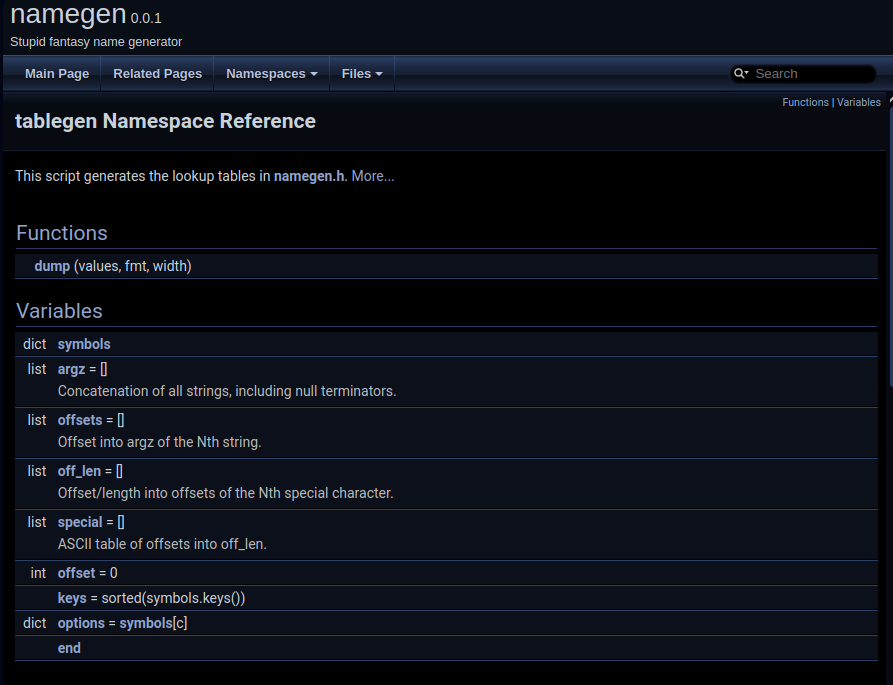
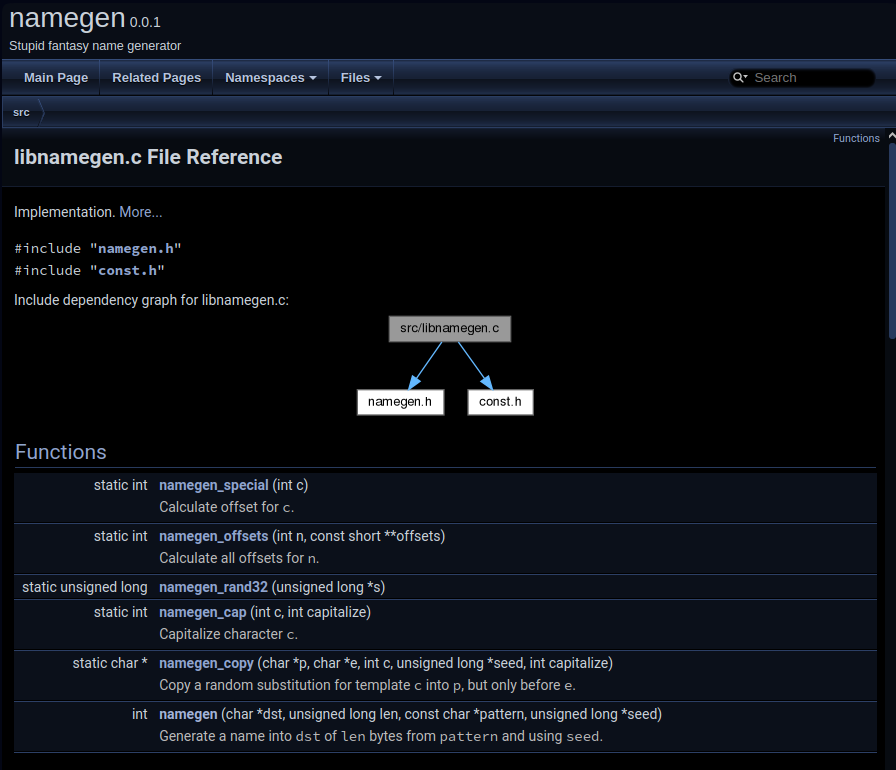
Документация поддерживает гиперссылки, а также (при предустановленной утилите Graphviz) графики зависимостей наших файлов.
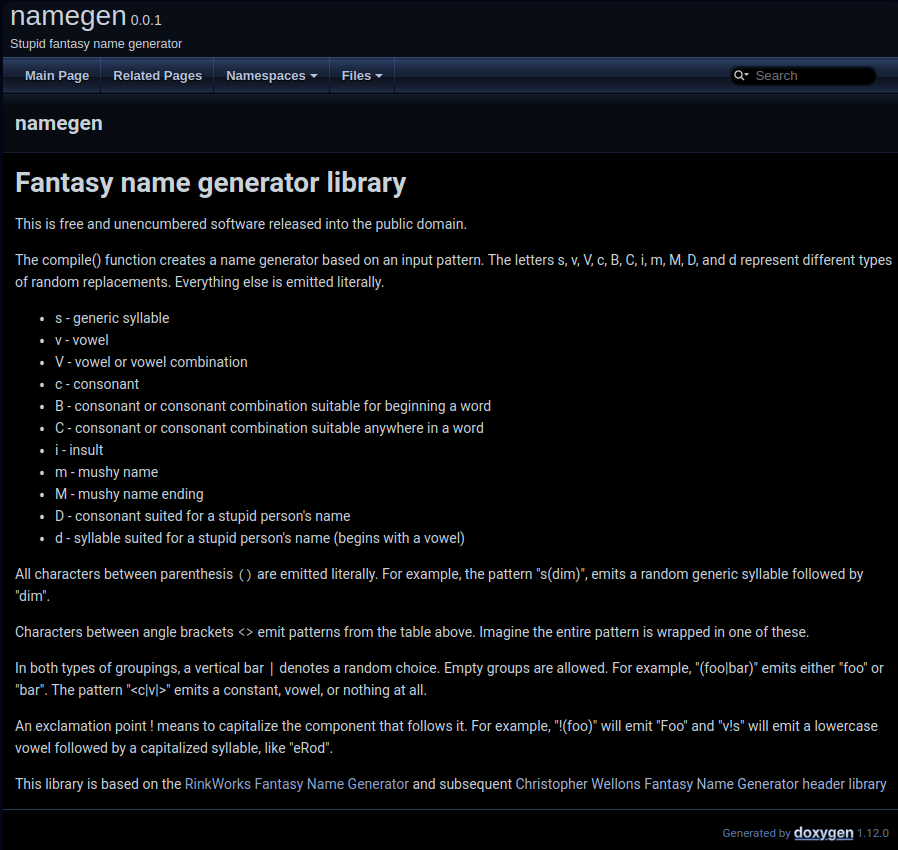
Отлично! Наша документация работает, однако сейчас не показывает главную страницу с документацией. Добавим для некоторых комментариев метку @mainpage для некоторых страниц, чтобы заполнить главный экран
Также мы хотим, чтобы нами генерируемая документация сохранялась при установке проекта извне. Поэтому соответсвующий рецепт указываем в Makefile.am
Makefile.am
SUBDIRS = src tests

@DX_RULES@

all-local:	doxygen-doc

install-data-local: # вот он
	mkdir -p $(DESTDIR)/$(docdir)
	cp -a doxygen-doc/html $(DESTDIR)/$(docdir)

demo:	all
	./src/namegen '!BVCs !DdM'

checklog:	check
	cat tests/*.log

gcov:	check
	$(MAKE) $(MAKEFLAGS) -C src gcov

http:	doxygen-doc
	python3 -m http.server --directory $</html 5000
Теперь добавим генерацию других документов, например, man
Для создания Мана можно пользоваться макропакетами и спецформатами (например, troff) или просто конвертировать текстовые исходники (с помощью txt2man, scdoc и другие конверторы)
Мы же напишем man на нашем же Doxygen, он умеет создавать и такие генераты.
Для начала включаем параметр в Doxyfile.in
@@ -2226,7 +2226,7 @@ RTF_EXTRA_FILES        =
 # classes and files.
 # The default value is: NO.

-GENERATE_MAN           = NO
+GENERATE_MAN           = YES

 # The MAN_OUTPUT tag is used to specify where the man pages will be put. If a
 # relative path is entered the value of OUTPUT_DIRECTORY will be put in front of
@@ -2244,7 +2244,7 @@ MAN_OUTPUT             = man
 # The default value is: .3.
 # This tag requires that the tag GENERATE_MAN is set to YES.

-MAN_EXTENSION          = .3
+MAN_EXTENSION          = .1
Внесём man-информацию в файл с кодом
namegen.c
#include "config.h"
#include "namegen.h"
#include <time.h>
#include <stdio.h>
#include <stddef.h>
#include <stdlib.h>
#include <string.h>

static unsigned long
hash32(unsigned long a)
{
    a = a & 0xffffffffUL;
    a = (a ^ 61UL) ^ (a >> 16);
    a = (a + (a << 3)) & 0xffffffffUL;
    a = a ^ (a >> 4);
    a = (a * 0x27d4eb2dUL) & 0xffffffffUL;
    a = a ^ (a >> 15);
    return a;
}

/*Добавили man*/

/** @page namegen
 * Fantasy name generator
 * @section SYNOPSIS
 * `namegen` \a pattern [ \a number ]
 * @section DESCRIPTION
 * Generate a fantasy name (or a \a number of names, if \a number is provided) according to \a pattern.
 *
 * @copydetails library
 */
int
main(int argc, char **argv)
{
    int i;
    int count = 1;
    FILE *urandom;
    unsigned char randbuf[4];
    unsigned long seed[] = {0x8af611acUL};

    /* Parse command line arguments */
    if (argc < 2 || argc > 3 || !strcmp(argv[1], "-h") || !strcmp(argv[1], "--help")) {
        printf("Usage: %s <pattern> [num]\n", argv[0]);
        printf("  pattern   template for names to generate\n");
        printf("  num       number of names to generate\n");
        exit(EXIT_FAILURE);
    } else if (argc == 3) {
        count = atoi(argv[2]);
    }

    /* Shuffle up the seed a bit */
    urandom = fopen("/dev/urandom", "rb");
    if (urandom && fread(randbuf, sizeof(randbuf), 1, urandom)) {
        unsigned long rnd =
            (unsigned long)randbuf[0] <<  0 |
            (unsigned long)randbuf[1] <<  8 |
            (unsigned long)randbuf[2] << 16 |
            (unsigned long)randbuf[3] << 24;
        *seed ^= rnd;
        fclose(urandom);
    } else {
        void *p = malloc(4UL * 1024 * 1024);
        *seed ^= hash32(time(0));             /* Current time */
        *seed ^= hash32((ptrdiff_t)main);     /* ASLR entopy */
        *seed ^= hash32((ptrdiff_t)seed);     /* Stack gap entropy */
        *seed ^= hash32((ptrdiff_t)p);        /* Allocator entropy */
        *seed ^= hash32((ptrdiff_t)malloc);   /* C library ASLR */
        free(p);
    }

    /* Generate some names */
    for (i = 0; i < count; i++) {
        char buf[256];
        int r = namegen(buf, sizeof(buf), argv[1], seed);
        if (r == NAMEGEN_INVALID) {
            fprintf(stderr, "%s: invalid pattern\n", argv[0]);
            exit(EXIT_FAILURE);
        }
        printf("%s\n", buf);
    }
    return 0;
}
Добавим в Makefile рецепт по генерации man
Makefile.am
SUBDIRS = src tests

@DX_RULES@

all-local:	doxygen-doc

doxygen-doc/man/man1/namegen.1:	doxygen-doc

man1_MANS = doxygen-doc/man/man1/namegen.1

install-data-local:
	mkdir -p $(DESTDIR)/$(docdir)
	cp -a doxygen-doc/html $(DESTDIR)/$(docdir)

demo:	all
	./src/namegen '!BVCs !DdM'

checklog:	check
	cat tests/*.log

gcov:	check
	$(MAKE) $(MAKEFLAGS) -C src gcov

http:	doxygen-doc
	python3 -m http.server --directory $</html 5000
Проверим, что наш man (а с ним и какой-никакой --help) отлично генерируется и работает
user@localhost:~/LinuxAppDev/11_Documenting/Lection/namegen> man ./doxygen-doc/man/man1/namegen.c.1


src/namegen.c(1)            General Commands Manual            src/namegen.c(1)

NAME
       src/namegen.c

SYNOPSIS
       #include 'config.h'
       #include 'namegen.h'
       #include <time.h>
       #include <stdio.h>
       #include <stddef.h>
       #include <stdlib.h>
       #include <string.h>

   Functions
       static unsigned long hash32 (unsigned long a)
       int main (int argc, char **argv)

Function Documentation
   static unsigned long hash32 (unsigned long a) [static]
   int main (int argc, char ** argv)
Author
       Generated automatically by Doxygen for namegen from the source code.

namegen                          Version 0.0.1                 src/namegen.c(1)
Домашнее задание
Взять за основу программу для угадывания чисел из старого Д/З
- Дописать к ней две функции — перевод из римской системы счисления и обратно
- Поскольку диапазон
1…100, проще всего сделать табличку на 100 элементов при помощи roman)
- Поскольку диапазон
- Научить саму программу принимать из командной строки параметр
-rдля работы в римской системе счисления - Задокументировать эти функции (и, возможно, другие, буде они у вас есть), а так же макросы и глобальные переменные (которые сочтёте нужными)
- Обеспечить программе вменяемый
--help(на двух языках!) иman(на одном) - Заполнить этим
help-ом титульную страницу документации
Некоторые подробности
- Титульную страничку придётся генерировать чем-то боле сложным, чем
LC_ALL=C ./number-game --help. Например, научить саму программу чему-то вроде--help-md(в который она подставляет командыDoxygen) или обработать--hеlpчем-то ещё - Если ничего не поможет, забейте и тупо скопируйте. Ну не будет у вас титульная страница генератом, возможно, начнёт расходиться с
--helpиman, и что? - (необязательно, для тех, кто хочет поупражняться программировать на Си) Увеличить диапазон до
1…3999